Blog
Mattress Depth Guide How Thick Should Yours Actually Be

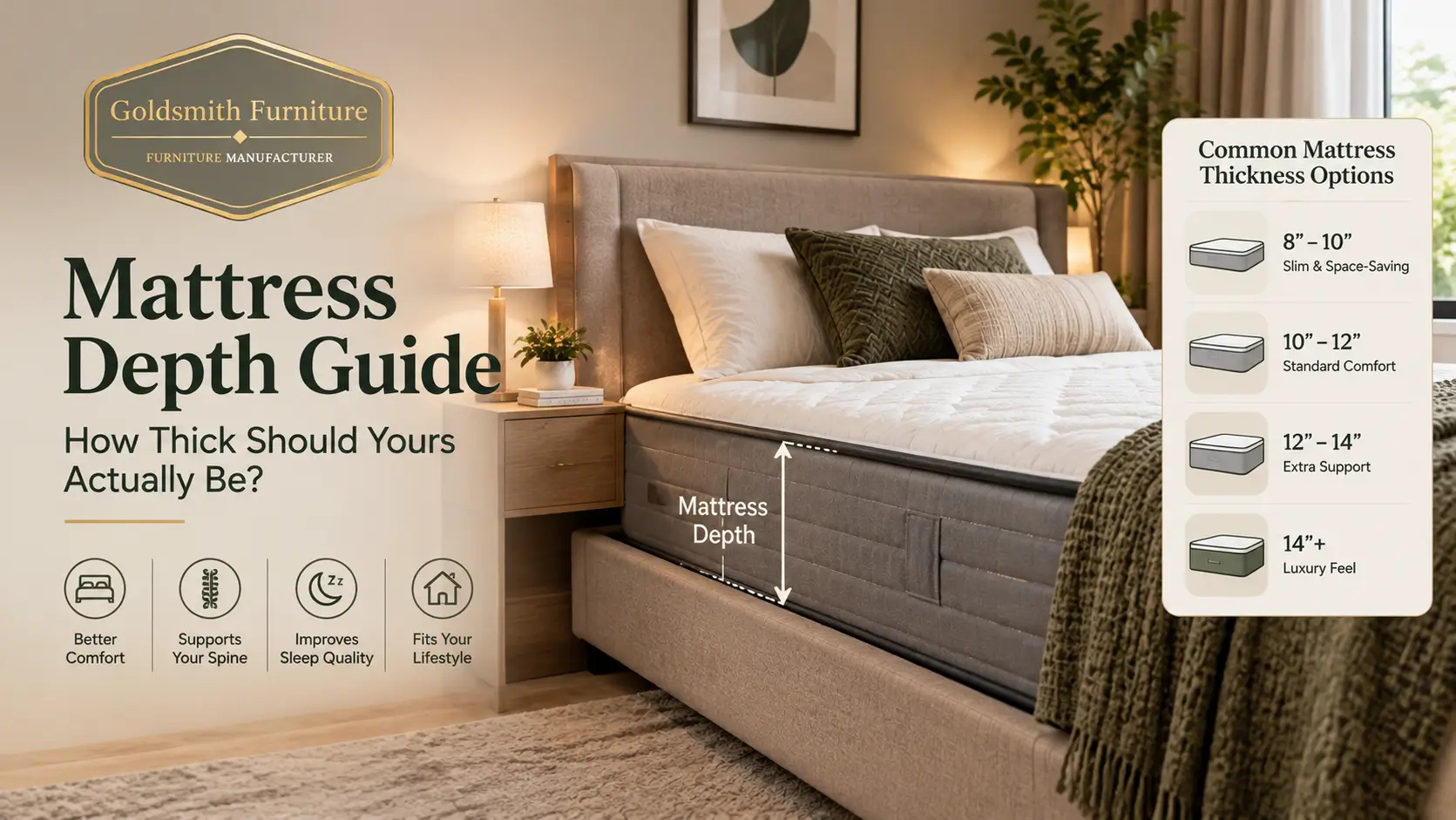
Mattress depth gets far less attention than size or firmness when people shop for a new mattress, yet it affects several practical things at once, from whether your existing fitted sheets will still fit to how easy the finished bed is to get in and out of. This guide explains what the standard depth ranges actually mean, what changes as depth increases, and the one practical calculation most buying guides leave out entirely, which is how mattress depth combines with your base height to determine the total height of the finished bed.
We supply mattresses across a genuine depth range from our Belfast workshop, alongside the bed bases we build ourselves, so we regularly help customers work through exactly this calculation before they order.
Standard Mattress Depth Ranges
UK mattress depth is generally measured in centimetres, and falls into three broad categories that most manufacturers work within.
Mattress Depth Categories
| Category | Typical Depth | Best Suited To |
|---|---|---|
| Low Profile | Under 20cm | Kids beds, bunk beds, guest and day beds |
| Standard | 20cm to 30cm | Most adult sleepers, the most common range sold |
| Deep | 30cm and above | Extra cushioning, orthopedic support, heavier sleepers |
A deeper mattress is not automatically better. Extra depth generally comes from additional comfort layers on top of the support core, which changes the feel of the mattress but does not necessarily improve durability or support on its own. A well built 22cm mattress can genuinely outperform a poorly built 35cm one.
Why Mattress Depth Affects Your Bedding
Fitted sheets are sized to a specific pocket depth, and buying the wrong category is one of the most common mattress related frustrations people run into after a purchase. Sheets sold as standard depth are generally cut for mattresses up to around 28cm. Anything deeper than that needs a sheet specifically labelled as extra deep or deep fitted, or the corners will simply not stay in place.
If you are moving from a slim or standard mattress to a deep one, check your current fitted sheets against the new mattress depth before assuming they will still work. This is a small detail that gets overlooked surprisingly often and leads to an unnecessary extra purchase right after the mattress itself arrives.
Duvets and duvet covers are not affected by mattress depth in the same way, since they drape over the top and sides of the bed rather than being fitted to a specific pocket size. Pillow depth is similarly unaffected. Fitted sheets remain the one bedding item where mattress depth genuinely changes what you need to buy.
Mattress Depth and Body Weight
Heavier sleepers generally benefit from a deeper mattress, since more material in the comfort and support layers resists compressing all the way through to the firmer base underneath. A mattress that is too shallow for a heavier sleeper can develop a bottoming out feeling over time, where the softer top layers compress fully and the sleeper effectively rests against the firmer support core underneath with little cushioning left.
Lighter sleepers do not need the same depth to get adequate support, and going deeper than necessary mainly adds cost without a meaningful improvement in comfort or support. For an average adult, a mattress in the standard 20cm to 30cm range is genuinely sufficient in the large majority of cases.
How Mattress Construction Affects Depth
Not all depth is built the same way, and understanding what makes up that depth explains why two mattresses at the same measurement can feel very different. A pocket sprung mattress typically has a spring layer forming the base of its depth, topped with a comfort layer of foam or natural fillings. The spring layer does most of the structural work, while the comfort layer above it contributes to the feel without adding much genuine support.
A foam mattress builds its depth differently, layering different densities of foam on top of each other, with a firmer support foam at the base and progressively softer comfort foam above it. This means a 25cm foam mattress and a 25cm pocket sprung mattress can feel quite different underneath you, even though the overall depth measurement is identical, since the construction doing the work underneath that depth number is not the same.
The Calculation Most Guides Miss: Total Bed Height
Mattress depth on its own only tells part of the story. The base underneath the mattress, whether that is a divan, an ottoman, or a standard slatted frame, adds its own height on top of the mattress depth, and the combined total is what actually determines how high the finished bed sits, and how easy it is to get in and out of.
A deep mattress on a tall divan base can result in a genuinely high bed that some people find awkward to get in and out of, particularly older adults or anyone with mobility considerations. The same deep mattress on a lower profile base gives a completely different practical result. Always check the base height as well as the mattress depth, and add the two together, rather than judging either one in isolation.
This calculation matters just as much in the other direction. Pairing a shallow, low profile mattress with a tall base can leave the finished bed looking visually unbalanced, with a headboard proportioned for a higher overall bed height than the mattress actually delivers. Working out the combined height before ordering avoids both problems, rather than discovering the mismatch once everything has already arrived.
Frequently Asked Questions
What is a standard mattress depth in the UK
Most UK mattresses fall between 20cm and 30cm in depth, which covers the large majority of adult mattresses sold. Deeper mattresses above 30cm are generally marketed as luxury or orthopedic options.
Do I need extra deep fitted sheets for every mattress
Only if your mattress depth exceeds around 28cm. Standard fitted sheets are cut for mattresses up to that depth, and anything deeper needs a sheet specifically labelled as extra deep to fit properly around the corners.
Is a deeper mattress always more comfortable
Not necessarily. Depth mainly reflects how many comfort layers sit on top of the support core, which affects feel rather than guaranteeing better comfort or durability. A well built mattress at a standard depth can outperform a poorly built deep one.
How does mattress depth affect getting in and out of bed
Mattress depth combined with base height determines the total bed height. A deep mattress on a tall base can create a genuinely high bed that some people, particularly older adults, find harder to get in and out of, so it is worth checking both measurements together rather than mattress depth alone.
Should heavier sleepers always choose a deeper mattress
Generally yes, since a deeper mattress gives more material to resist compressing fully under greater weight. This helps avoid a bottoming out feeling that can develop on a shallower mattress over time under heavier, sustained use.
Does mattress depth affect price
Generally yes, since a deeper mattress uses more material across its comfort and support layers, which adds to manufacturing cost. This is not a fixed rule across every brand, but depth is one of several factors that typically influences price alongside the quality of springs, foam, and fillings used.
Can I add a topper instead of buying a deeper mattress
A mattress topper can change the feel of the sleeping surface without replacing the mattress itself, and is a reasonable option if you want a softer feel on an existing mattress. It does not, however, address genuine support issues from an undersized mattress, and it adds its own few centimetres to the total depth, which is worth factoring into fitted sheet and bed height calculations.
Is mattress depth the same as mattress firmness
No, these are separate measurements. Depth refers to the physical thickness of the mattress in centimetres, while firmness describes how much the surface compresses and how supportive it feels. A mattress can be deep and soft, deep and firm, shallow and soft, or shallow and firm, since the two characteristics are determined by different aspects of the construction.
Choosing the Right Depth
Start with the standard 20cm to 30cm range unless you have a specific reason to go deeper, such as notably higher body weight or a clear preference for a plush, heavily cushioned feel. Check your fitted sheets against the depth before ordering, and always add the mattress depth to your base height to understand the actual finished height of the bed, rather than considering either measurement in isolation.
Getting this right at the outset avoids two of the most common post purchase frustrations, an ill fitting fitted sheet and a bed that sits higher or lower than expected once the mattress and base are combined. Both are easy to check before ordering and far more of a hassle to fix afterwards.