Blog
UK Bed Size Guide Every Bed Dimension Explained for Your Home

Choosing the right bed size is one of the most practical decisions you will make when furnishing a bedroom, and it is also one of the easiest to get wrong. A bed that looks perfectly reasonable in a showroom or on a product page can turn out to be too large for the room once it is actually assembled, or too small once two people are sharing it every night. This guide sets out every standard UK bed size in full, explains what each one actually feels like to sleep in, and covers the specific measuring problems that come up again and again in Northern Ireland homes, from narrow Belfast terrace staircases to tight box rooms in newer developments.
We build every bed frame we sell by hand in our own workshop on Hillview Road in Belfast, and our delivery team fits frames into homes across Northern Ireland every working day. The advice below comes from that direct experience, not from a manufacturer’s spec sheet alone.
What Are the Standard UK Bed Sizes
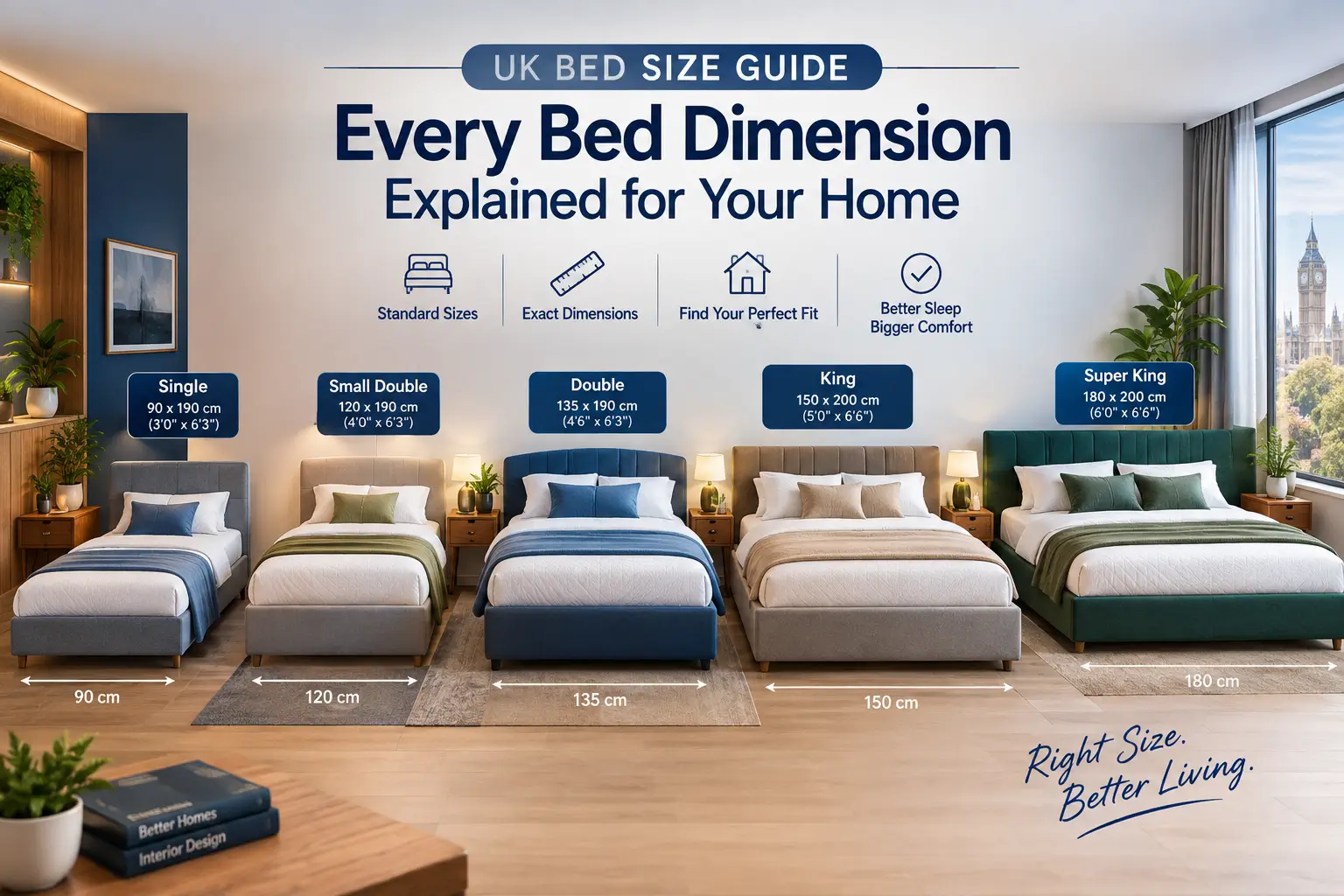
There are six sizes used consistently across the UK bed and mattress industry. Every bed frame is built to hold a specific mattress size, so the frame name always follows the mattress it is designed for.
UK Bed Size Chart
| Bed Size | Width | Length | Feet and Inches |
|---|---|---|---|
| Small Single | 75cm | 190cm | 2 feet 6 inches by 6 feet 3 inches |
| Single | 90cm | 190cm | 3 feet by 6 feet 3 inches |
| Small Double | 120cm | 190cm | 4 feet by 6 feet 3 inches |
| Double | 135cm | 190cm | 4 feet 6 inches by 6 feet 3 inches |
| King Size | 150cm | 200cm | 5 feet by 6 feet 6 inches |
| Super King | 180cm | 200cm | 6 feet by 6 feet 6 inches |
Small Single is the smallest standard size and is mostly used in children’s rooms or box rooms where floor space is extremely limited.
Single is the standard size for one adult, and the most common choice for teenage bedrooms, guest rooms, and student accommodation.
Small Double is sometimes called a queen size in casual conversation, though queen size is not an official UK bed size. This size works well for a single adult who wants extra room to stretch out, or for two people in a smaller bedroom who do not need full double width.
Double remains the most popular bed size sold in the UK. It comfortably fits two adults without dominating a standard sized bedroom, which is why it works well in most Northern Ireland homes built from the 1960s through to today.
King Size is 15cm wider than a double and 10cm longer, giving noticeably more shoulder room for two people sharing, along with extra length that taller sleepers will appreciate.
Super King is the largest bed size sold as standard in the UK. It suits larger master bedrooms and gives two adults close to the same personal space each that they would have in a single bed.
What Does Each Bed Size Typically Cost
Bed frame prices vary by style and material, not just size, so treat the figures below as a realistic starting range rather than a fixed price. These are based on our own current range at Goldsmith Furniture.
Starting Price Guide by Frame Style
| Frame Style | Typical Starting Price |
|---|---|
| Divan base frames | From £170 |
| Chesterfield and wingback styles | From £250 |
| Panel and upholstered mid range styles | From £285 |
| Premium upholstered styles such as Amour | From £400 |
| Extra large styles such as Madrid XL and storage ottoman frames | From £450 |
As a general rule, moving up in bed size within the same style typically adds to the price because more material and labour go into a larger frame. Moving between styles at the same size can change the price more than the size itself does, since a simple divan base will always cost less than a fully upholstered wingback frame in the same dimensions.
How to Measure Your Bedroom Before Buying a Bed Frame
The mattress size tells you how big the sleeping surface will be, but it does not tell you how big the finished bed frame will actually be once it is built. A double bed frame with a solid headboard and footboard can easily add 10 to 15cm to the overall footprint beyond the 135cm by 190cm mattress size, and upholstered frames with thicker side rails add even more.
Before ordering, measure your room and mark out the full frame dimensions on the floor with tape, not just the mattress size. Leave at least 60cm of clear walking space on at least one side of the bed and at the foot of the bed, so the room remains usable day to day rather than feeling like the bed has taken it over.
If your bedroom is an awkward shape, common in older Belfast terraces where bedrooms were often built above narrower rooms downstairs, measure the widest usable rectangle in the room first, then work out which bed size actually fits that rectangle rather than assuming a king size will fit just because the room looks reasonably large.
Getting a New Bed Frame Into an Older Northern Ireland Home
This is the part most bed size guides skip entirely, and it causes more delivery problems than the wrong mattress size ever does. Northern Ireland has a large amount of older housing stock, particularly in Belfast, Lisburn, and other towns with Victorian and Edwardian terraces. These homes were built long before modern bed sizes existed, which means staircases can be narrow, landings can involve a sharp turn, and doorways are sometimes 5 to 10cm tighter than in a modern new build.
A made up bed frame, especially a solid wood or upholstered super king, may simply not go around a tight staircase turn in one piece. This is exactly why we build our frames to be assembled inside the bedroom rather than delivered fully built. The frame components go up the stairs individually, then our delivery team assembles the bed in the room itself. If you live in an older property with a narrow staircase or an awkward turn on the landing, mention this when you order, so we can plan the delivery properly rather than discovering the problem on the day.
Newer developments across Northern Ireland tend to have wider stairwells and doorways, but often smaller bedrooms overall, particularly in second and third bedrooms built to a more compact standard. In these homes, the more common issue is not getting the bed into the room, but the bed leaving no usable floor space once it is in there. A small double or double with genuine storage built into the base, such as an ottoman or divan design, often solves this better than simply choosing a smaller mattress size.
Choosing the Right Size for How You Actually Sleep
Bed size is not only about the size of the room. It is also about who is using the bed and how.
A single adult sleeping alone is comfortable on a single or small double in most cases. A small double gives noticeably more room to stretch out compared with a standard single, without needing the space a full double requires.
Two adults sharing a bed long term are generally better suited to a king size than a double, even though a double is technically large enough for two people. The extra 15cm of width in a king size makes a real difference to sleep quality for couples, since it reduces the chance of disturbing each other during the night.
Families with young children who end up in the parents bed regularly, even occasionally, often find a super king genuinely earns its higher price by giving enough room for three people without anyone sleeping right on the edge.
Taller sleepers, generally above 6 feet, should pay attention to length as well as width. All standard UK double, king, and super king sizes share the same 200cm length, other than the 190cm length used on single and small double frames, so moving up from a double to a king does not add extra legroom. If length is the main issue rather than width, this is worth knowing before assuming a wider bed will solve the problem.
Frequently Asked Questions
What is the most popular bed size in the UK
Double remains the most popular bed size sold across the UK, largely because it fits comfortably into a standard sized bedroom while still working for two adults.
Is a king size bed much bigger than a double
A king size bed is 15cm wider and 10cm longer than a double. The width difference in particular makes a noticeable difference to comfort for two people sharing.
What size bed fits a small bedroom
A single or small double tends to fit best in a genuinely small bedroom, particularly once you account for wardrobe space and walking room. A double can still work in a small room if the layout is planned carefully, but a king or super king generally needs a larger room to avoid overwhelming the space.
Do bed frames add much size beyond the mattress dimensions
Yes. Depending on the frame style, expect the finished frame to be 10 to 15cm larger than the mattress size in both length and width, sometimes more with upholstered designs. Always check the exact frame dimensions rather than relying on the mattress size alone.
Can a super king bed fit up a narrow staircase
It depends on the staircase and the frame design. This is why we build and assemble our frames on site rather than delivering them fully constructed, since a solid super king frame is far more likely to face access problems than one that goes up the stairs in individual pieces and is assembled in the bedroom.
Choosing the Right Bed Size With Confidence
Getting the bed size right comes down to three things: measuring the room properly and accounting for the full frame size rather than just the mattress, being honest about who will actually be using the bed and how, and thinking about how the bed will physically get into the room if you live in an older property. Get those three right, and the size decision becomes straightforward.
If you would like advice specific to your own bedroom, our team regularly helps customers work through exactly this before ordering. You can browse our full range of handmade bed frames across every UK size, or get in touch directly with your room measurements and we will help you choose the right fit.